
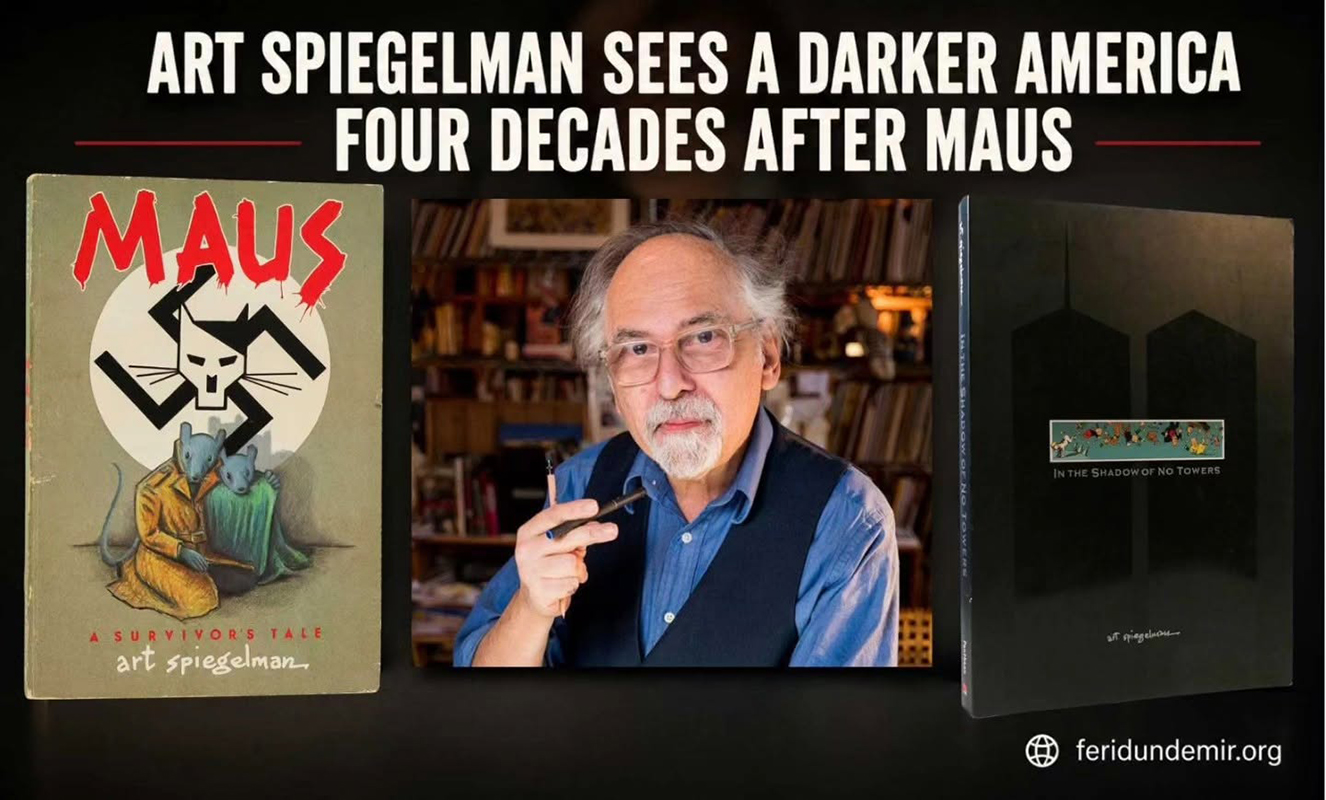
Спустя четыре десятилетия после выхода «Мауса» Арт Шпигельман смотрит на Америку и видит тревожные отголоски прошлого.
В новом интервью художник-карикатурист, лауреат Пулитцеровской премии, рассуждает о Трампе, авторитаризме, цензуре и о том, почему политическая карикатура по-прежнему важна.
Four decades after Maus, Art Spiegelman looks at America and sees troubling echoes of the past.
In a new interview, the Pulitzer Prize-winning cartoonist reflects on Trump, authoritarianism, censorship, and why political cartooning still matters.
https://feridundemir.org/2026/08/17/art ... grtaOQnsvw
More than four decades after Maus made Art Spiegelman one of the most influential figures in contemporary comics, the cartoonist is looking at the political landscape of the United States with growing concern.
In a new interview published by The Guardian on August 15, the 78-year-old artist speaks about Donald Trump, civil liberties, the legacy of September 11 and his concerns about fascism in the United States.
Politics has never been far from Spiegelman’s work. From his roots in underground comics and the founding of RAW with Françoise Mouly to Maus and his later work responding to 9/11, he has repeatedly used comics to confront history, politics and personal memory.
Maus remains his best-known work. Built around the experiences of his father, Vladek, a Holocaust survivor, the book also explores the complicated relationship between father and son. Spiegelman received a special Pulitzer citation for Maus in 1992, recognition that helped push his work far beyond the traditional boundaries of the comics world.
September 11 marked another turning point.
Spiegelman and his family were living in Lower Manhattan when the attacks took place. In the work that followed, his focus extended beyond the immediate horror of the attacks to the political climate that developed in the United States afterward. Those drawings and reflections were collected in In the Shadow of No Towers, published in 2004.
Twenty-five years later, Spiegelman says his perspective on 9/11 has changed. What once felt almost apocalyptic now sits within a longer and, in his view, increasingly troubling political history.
It is his assessment of present-day America that provides some of the strongest remarks in the new interview.
Spiegelman uses the term “fascism” in discussing the political direction of the United States under Trump. He does not suggest that America is simply repeating the fascist regimes of the past, but sees patterns in the current political climate that he believes are recognizable from history.
For Spiegelman, American democracy has always fallen short of its stated ideals. What matters, he argues, is that those ideals existed as something the country was expected to measure itself against. He now questions how much of that framework remains intact.
His criticism of Trump and authoritarian tendencies in American politics predates the latest interview. These concerns have appeared in both his art and public statements over the years.
Spiegelman’s career has long been shaped by questions of memory: how the past is recorded, how trauma survives from one generation to another, and how history can be represented through images. With Maus, those questions were rooted in the Holocaust and his own family. After 9/11, they became tied to events he had witnessed himself.
More than forty years after Maus, Spiegelman is still dealing with history, memory and authoritarianism. This time, much of his attention is fixed on the America around him.
Sources:
The Guardian — Sophie McBain, “Art Spiegelman: ‘The US needs a counter-revolution’,” August 15, 2026.
https://www.theguardian.com/books/ng-in ... revolution
The Pulitzer Prizes — Art Spiegelman, 1992 Special Citations and Awards, for Maus.
https://www.pulitzer.org/winners/art-spiegelman
Penguin Random House — In the Shadow of No Towers by Art Spiegelman.
https://www.penguinrandomhouse.com/book ... piegelman/
Penguin Random House — Art Spiegelman, author biography.
https://www.penguinrandomhouse.com/auth ... piegelman/



